
Your CEO Asks the Same Question Twice. Does the Answer Change?
.webp)

Monday, 9 a.m. Your CEO asks the AI agent for Q3 revenue. It says $4.21M.
Friday, 4 p.m. Same CEO. Same question. Same agent. This time it says $4.37M.
(The numbers are made up. The meeting that follows: very real.)
Raise your hand if this sounds frustratingly familiar: Finance pulls up revenue_final. Analytics defends revenue_corrected, and someone in the back points out a third column called plain old revenue, which three dashboards still read.
What is the cost of a wrong number?
A wrong number, on its own, may not seem to be that big of a deal. You (with your tribal knowledge and experience) spot it, fix it, and keep going. It causes delays in decision-making, and puts your sharpest analysts on referee duty, but it’s survivable.
That process isn’t scalable, and it becomes an expensive dealbreaker with AI agents in the mix. Agents don’t have your context, and they end up delivering different answers every time you ask the same question.
Now the CEO starts asking for numbers verified by an analyst, and your AI program just lost its sponsor. AI pilots die exactly this way.
Why does the answer drift?
Two problems why.
Problem one: The model rolls dice, even at temperature zero
LLMs choose each next word by probability. When an LLM writes your SQL, every table name, join key, and filter is a probability pick. Flip one token, and SUM(revenue_final) becomes SUM(revenue_corrected).
So, if you turn the temperature to zero, the output should be the same every time, right?
Wrong.
Researchers at Thinking Machines Lab ran one prompt through a large model 1,000 times at temperature zero and got 80 distinct completions back.
Why? The cause is how servers batch requests together: the batch size shifts the underlying math.
For the poet, variety is charming. For the analyst presenting a board deck to their CEO, it's a reason to start updating your LinkedIn.
Problem two: The model has never met your business
Suppose you fixed the dice. A perfectly repeatable wrong answer is still wrong.
On BIRD, a text-to-SQL benchmark spanning 95 real databases across 37 professional domains, GPT-4 reached 54.89% execution accuracy while humans reached 92.96% (Li et al., NeurIPS 2023).
Why the gap? The benchmark authors point to dirty, noisy values and the outside knowledge needed to connect a question's words to what actually sits in the database.
Your warehouse has three revenue columns. Only one got finance's sign-off. The model has no way to know which, so it guesses.
How WALT ensures same question, same answer, every single time
Short answer: neuro-symbolic AI. The LLM handles language, which it does well. Deterministic logic handles the SQL, which has to come out identical every single time.
Every question travels the same four steps:
1. Intent classification: The LLM reads "What was Q3 revenue?" and turns it into structured intent: metric equals revenue, period equals Q3. It doesn’t do SQL.
2. Definition lookup: The ReasonBase™ Data Context Graph resolves "revenue" to the single definition your data steward approved. That definition lives in human-readable YAML, with every version logged.
3. Pattern selection: Stable Logic Models pick a proven analytical pattern, such as time-over-time, cohort analysis, or a fanout-protected join. These patterns encode query shapes known to be safe.
4. SQL compilation: An abstract syntax tree compiler builds the query from the definition and the pattern. No probability touches this step.
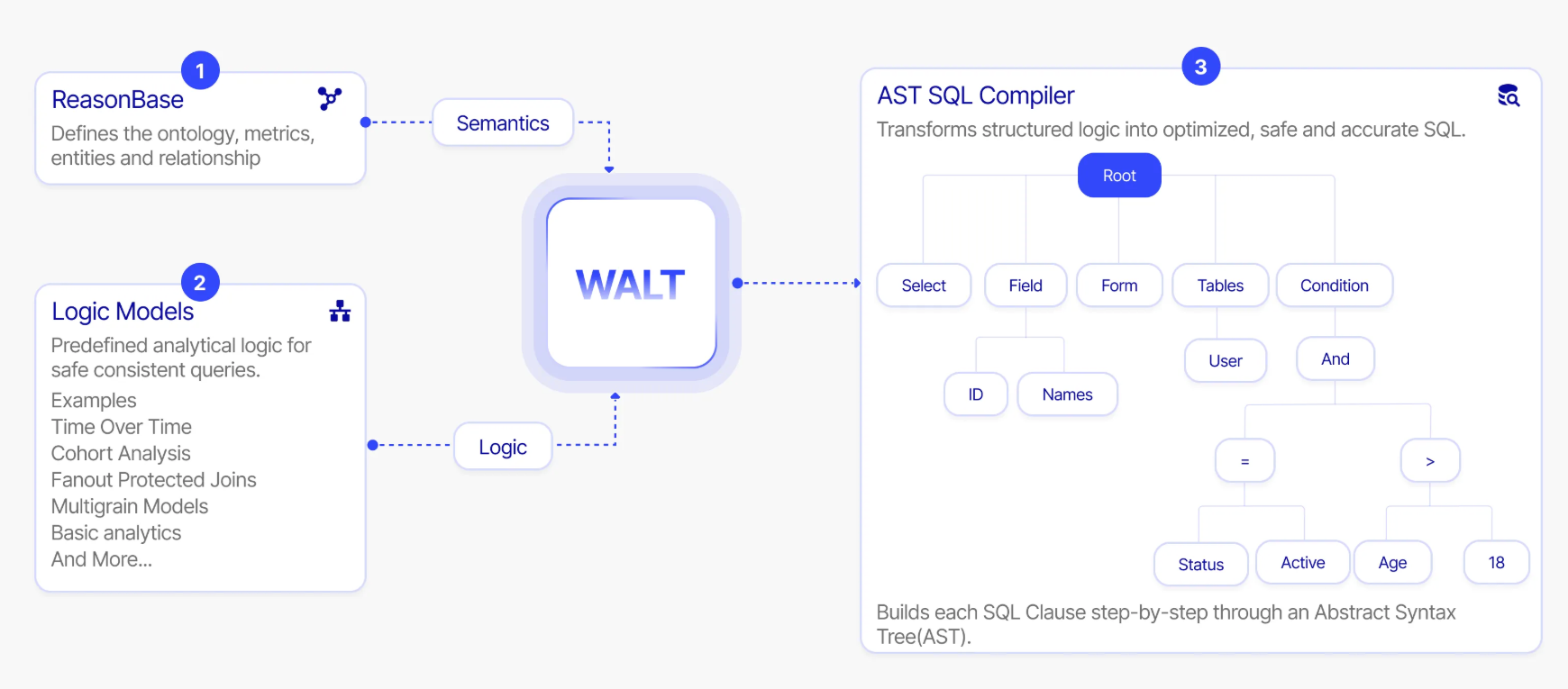
Monday's SQL matches Friday's, character for character. So does the answer.
In production, this architecture delivers 95% query accuracy (F1 score) and close to 100% consistency across enterprise datasets. It already runs at publicly listed companies in retail, financial services, marketing, and technology.
"Does this replace my data engineers?"
No. Be wary of anyone who claims their agent does.
Grunt work goes to WALT: tracing three revenue columns back to their origins, mapping lineage, rewriting semantic models every time a schema shifts. That's the tribal knowledge work that walks out the door when an analyst quits.
Humans keep the judgment calls. Data stewards approve every definition before it goes live, and they can edit or roll back any of them.
"Great. Another tool for my bloated stack."
Fair. You already pay for Snowflake, dbt, Tableau, and probably a catalog nobody fully trusts.
WALT runs on top of all of it. No lift and shift required. It reads your existing dbt models, BI dashboards, and query logs, and it syncs both ways with catalogs like Collibra and Alation.
And it does the work and leaves. The graph, the definitions, and the tribal knowledge stay with you, so if you fire us like you'd fire your SI, you keep everything WALT built.
Run the Friday test
Pick one question your CEO asked last quarter. Ask your current AI agent that question today, then again on Friday. Compare the SQL.
If both runs match, keep what you have. You don't need us.
Mismatch? Bring that question to us at Gartner IT Symposium/Xpo™ 2026, from October 19-22, 2026 at Walt Disney World Swan & Dolphin in Orlando, Florida. We'll run it twice while you watch, then walk you through the trail behind the answer.
Sources
Thinking Machines Lab: Defeating nondeterminism in LLM inference (2025)
Li et al.: Can LLM already serve as a database interface? (BIRD) (NeurIPS 2023)
WALT: Neuro-symbolic AI
.jpg)

Meet WALT, your next Data Engineer that builds and runs your entire data platform
.webp)

.webp)